

Calculate Photo Booth Business Profit: A Step-by-Step Guide
Table of Contents
- Understanding Photo Booth Business Profit Fundamentals
- Setting Your Photo Booth Pricing Structure
- Mapping Photo Booth Business Expenses
- Working Through a Photo Booth Break-Even Analysis
- Calculating Photo Booth Equipment ROI
- Accounting for Real-World Variables and Seasonality
- Conclusion
- Frequently Asked Questions
Last Updated: October 8, 2026
Understanding Photo Booth Business Profit Fundamentals
To calculate photo booth business profit, use this simple formula: revenue minus expenses. But most newcomers miss critical costs, underestimate downtime, and ignore seasonal swings that make or break cash flow.
Photo booth business profit depends on three things: how much you charge per event, how many events you book, and what it actually costs to run each one. Get any of these wrong, and your projections fall apart.
Profit is what's left after your printer vendor, transport, and equipment replacement fund are paid. If nothing remains, you have a hobby, not a business.
Setting Your Photo Booth Pricing Structure
Pricing determines whether the business works: too low and you never cover costs, too high and bookings dry up. The sweet spot depends on your market, competition, and delivered value.
Most operators charge hourly or per event; event-based pricing suits weddings and corporate functions with known durations.
Build your pricing around three layers:
- Base rate covers your essential costs: equipment depreciation, transport, insurance, and operator time
- Profit margin is what you keep after expenses, aim for 40-50% of your base rate as your target profit per booking
- Premium pricing for add-ons: custom backdrops, instant prints, digital copies, or props that increase perceived value
Calculate what one event costs to deliver, labour, printer consumables, electricity, fuel, and equipment depreciation, then price accordingly, leaving room for slow months.
Mapping Photo Booth Business Expenses
Every dollar you spend reduces profit. Most operators know equipment and printer costs but miss ongoing expenses that compound throughout the year.
Initial Equipment Investment
Your first major expense is the photo booth. A new professional-grade unit runs more; a refurbished model costs less. Aussie Photo Booth Supplies offers a Portable Photo Booth (Refurbished) at $4,495 including booth and printer, a solid starting point to test the business model without maximum upfront investment.
Beyond the booth itself, budget for:
- Printer (if not included): $2,000-$4,000
- Backdrops and props: $500-$2,000
- Lighting equipment: $1,000-$3,000
- Transport case or van modifications: $1,000-$5,000
- Software and CRM setup: $800-$2,000
Total startup cost can be a significant hurdle before your first booking generates profit.

Ongoing Operating Costs
Operating expenses happen whether you book events or not.
Monthly fixed costs:
- Insurance (equipment and liability): $100-$300
- Vehicle costs (fuel, maintenance, registration): $200-$500
- Software subscriptions (CRM, booking platform): $50-$200
- Storage or workspace: $200-$800
Per-event variable costs:
- Printer consumables (paper, ink, adhesive): $15-$40 per event
- Operator labour (if you hire): $200-$400 per event
- Transport and setup time: factored into labour
Annual replacement and maintenance:
- Equipment repairs and parts: budget 5-10% of equipment value annually
- Software updates and training: $500-$1,000
- Marketing and advertising: $200-$1,000 monthly depending on growth stage
A realistic monthly operating budget for a solo operator can be a significant threshold you need to exceed with bookings.
Cost Category |
Monthly Range |
Annual Range |
|---|---|---|
Insurance |
$100-$300 |
$1,200-$3,600 |
Vehicle costs |
$200-$500 |
$2,400-$6,000 |
Software & CRM |
$50-$200 |
$600-$2,400 |
Storage/workspace |
$200-$800 |
$2,400-$9,600 |
Total Fixed |
$550-$1,800 |
$6,600-$21,600 |
Working Through a Photo Booth Break-Even Analysis
Your break-even point is the number of events you must book monthly to cover costs. Above it, everything is profit; below it, you're losing money. But a single number isn't enough, you need to see how it moves when assumptions change.
Here's how to calculate it:
Step 1: Add up your monthly fixed costs. Using the table above, let's assume $1,200 in fixed costs per month.
Step 2: Calculate your contribution per event. If you charge $500 per event and spend $50 on consumables and labour costs, your contribution per event is $450.
Step 3: Divide fixed costs by contribution per event. $1,200 ÷ $450 = 2.67 events.
You need approximately 3 bookings per month to break even. Below 3, you lose money. At 4 bookings, you make $450 profit. At 6 bookings, you make $1,350.
Sensitivity Analysis: How Break-Even Moves
A single break-even figure is fragile. The table below shows how it responds to price and cost changes, using the same $1,200 monthly fixed costs.
Scenario |
Price per event |
Variable cost per event |
Contribution per event |
Break-even events/month |
|---|---|---|---|---|
Low price, low cost |
$400 |
$50 |
$350 |
3.4 |
Base case |
$500 |
$50 |
$450 |
2.7 |
Higher price |
$600 |
$50 |
$550 |
2.2 |
Higher variable cost |
$500 |
$100 |
$400 |
3.0 |
Both price and cost rise |
$600 |
$100 |
$500 |
2.4 |
A $100 price increase cuts break-even by roughly half an event per month, while a $50 rise in variable costs adds about a third of an event. Small changes compound.
Scenario Planning: Conservative, Expected, Optimistic
Break-even tells you the minimum; scenario planning shows profit across realistic outcomes:
- Conservative: 2 bookings per month, $450 contribution per event. Monthly profit = (2 × $450) − $1,200 = −$300. You are losing money.
- Expected: 4 bookings per month, $450 contribution. Monthly profit = (4 × $450) − $1,200 = $600.
- Optimistic: 6 bookings per month, $450 contribution. Monthly profit = (6 × $450) − $1,200 = $1,500.
Now layer in seasonality: if your conservative case is winter and optimistic is November-December, annual profit isn't 12 × $600 but a weighted sum. A common pattern is 3 strong months, 6 average, 3 weak, model month by month, not as a flat average.
Booking Utilisation and Capacity
Break-even assumes you can book the events, but capacity is finite. A solo operator running a booth that takes 4 hours per event plus 2 hours setup, 2 hours teardown, and travel can realistically deliver 2-4 events per week at peak, 8-16 per month maximum.
If break-even is 3 events per month and capacity is 8, you have a buffer. If break-even is 6 and capacity is 8, you're one cancellation from a loss. Always compare break-even to capacity, not to your hopes.
Printer Rental Services | VIC Only | HiTi 525L →
Break-even analysis also reveals why CRM setup matters. Aussie Photo Booth Supplies offers Check Cherry CRM Setup starting at $795, simplifying bookings and cutting admin time, directly improving your contribution per event.
Calculating Photo Booth Equipment ROI
Return on investment measures how long profit takes to equal your initial equipment cost, but payback period isn't the same as cash in your pocket. This section separates accounting profit from cash flow, adds depreciation and replacement reserves, and shows where tax fits.
Here's the basic formula:
ROI (months) = Initial Equipment Cost ÷ Monthly Profit
Let's use a realistic scenario:
- Equipment investment: $15,000
- Monthly bookings: 4 events
- Profit per event: $400
- Monthly profit: $1,600
ROI = $15,000 ÷ $1,600 = 9.4 months
You recover your equipment investment in just over nine months.
Cash Flow vs Accounting Profit
Accounting profit subtracts depreciation; cash flow does not. Spend $15,000 on equipment in month one and cash flow is negative $15,000 that month, even if annual accounting profit looks positive. You must survive the cash trough before profit arrives.
A simple cash flow view for the first six months:
Month |
Bookings |
Revenue |
Variable costs |
Fixed costs |
Cash flow |
|---|---|---|---|---|---|
1 |
2 |
$1,000 |
$100 |
$1,200 |
−$300 |
2 |
3 |
$1,500 |
$150 |
$1,200 |
$150 |
3 |
4 |
$2,000 |
$200 |
$1,200 |
$600 |
4 |
4 |
$2,000 |
$200 |
$1,200 |
$600 |
5 |
3 |
$1,500 |
$150 |
$1,200 |
$150 |
6 |
2 |
$1,000 |
$100 |
$1,200 |
−$300 |
Cumulative cash flow after six months is $900, but you still haven't recovered the $15,000 equipment cost. Payback takes far longer than the simple ROI formula suggests once real booking patterns are accounted for.
Depreciation and Replacement Reserves
Your equipment wears out: printers need replacing, backdrops fade, laptops slow down. Without a replacement reserve, you'll fund it from profit later, or stop operating.
A common approach is reserving a percentage of equipment value annually. It isn't a cash expense that month, but it's a real cost, treat it as a line item in your profit calculation.
Depreciation for tax purposes differs from a replacement reserve. The Australian Taxation Office allows deductions for decline in value, and small business entities may immediately deduct assets below a threshold. Rules change, so check the ATO's current guidance or speak to a registered tax agent.
Taxes and Business Structure
Taxes vary by business structure, sole trader, partnership, company, or trust, and by total income. There's no single rate; account for tax as a percentage of profit and adjust with your accountant.
A practical method: estimate taxable profit, apply your expected marginal rate, and set that amount aside in a separate account. Sole traders pay their personal marginal rate; companies pay the company tax rate, with dividends taxed separately. GST also matters: if registered, you charge it on bookings and claim it on eligible purchases, but it isn't your money.
Sensitivity: What Changes ROI Most
The biggest ROI levers are bookings per month and profit per event. A 25% increase in bookings cuts payback by roughly 20%; a 25% price increase (if bookings hold) cuts it similarly; a 25% variable cost rise adds months. Model all three with conservative year-one assumptions.
Accounting for Real-World Variables and Seasonality
Your profit calculations only work if you account for how the real world actually behaves. Demand isn't flat. Costs aren't predictable. Utilisation varies wildly by season.
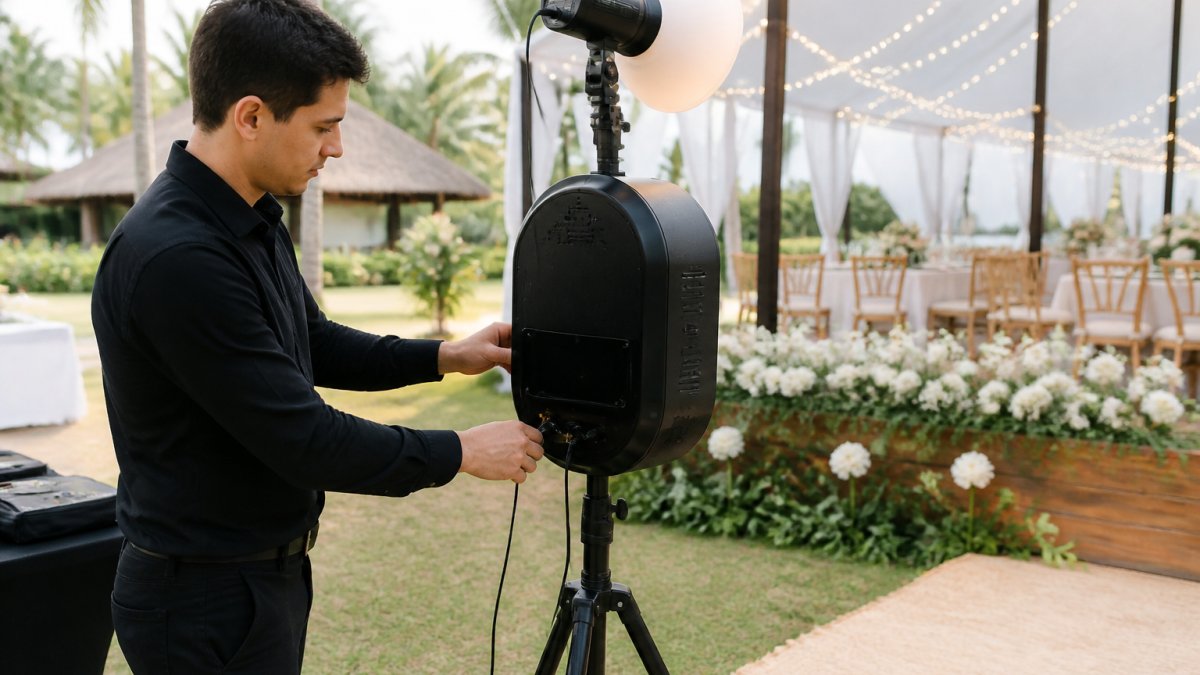
Seasonality is the biggest variable. In Australia, photo booth demand peaks October through December (weddings, Christmas parties, corporate events) and drops sharply in winter.
This creates cash flow problems: fixed costs don't change with the season, so you still pay insurance, software, and vehicle costs while revenue drops 60-70%.
Build a seasonal model:
- Calculate your peak-season booking rate (November-December)
- Calculate your low-season booking rate (June-August)
- Average them across 12 months to get a realistic annual projection
- Assume the first year is 20-30% slower than your model predicts
If you project 4 bookings per month on average, plan for 3. If you plan for 3, prepare for 2. Pessimism here is prudence.
Labour is the third variable. Solo, your labour cost is your time; once you book 6+ events monthly you'll need help. Operator labour runs $200-$400 per event, cutting profit per event by 40-50%.
Conclusion
To calculate photo booth business profit accurately, you must know your costs, booking rate, break-even point, and seasonal swings. Most operators skip this work and wonder why they're losing money.
If you're serious about launching a photo booth business, start with proper CRM and operational setup, the right tools and training eliminate guesswork. Aussie Photo Booth Supplies provides everything from equipment to CRM configuration; our Check Cherry CRM Setup packages handle booking automation, payment processing, and customer management so you can focus on delivering great events. With the right foundation, your profit calculations become predictions you can actually hit.
Frequently Asked Questions
How do you calculate profit for a photo booth business?
Profit equals your total revenue minus all expenses. Start by multiplying your average booking rate by the number of events you expect to complete in a month. Then subtract fixed costs (equipment depreciation, insurance, CRM software) and variable costs (consumables, travel, labour). The result is your net profit. This calculation works best when you track actual booking data for 3–6 months to refine your revenue estimates and identify seasonal patterns.
What is a realistic profit margin for a photo booth rental business?
Gross profit margins vary by market demand, pricing strategy, and operational efficiency. A margin means that a portion of your charge per event covers direct costs and the remainder contributes to overhead and net profit.
How many events does a photo booth business need to break even?
Break-even depends on your total startup costs and monthly profit per event. You also have monthly overheads (insurance, CRM, vehicle costs) that extend the timeline. Seasonality matters significantly.
What expenses should I include when calculating photo booth business profit?
Include both fixed and variable costs. Fixed costs are those you pay monthly regardless of bookings: equipment depreciation, insurance, CRM software, vehicle expenses, and phone/internet. Variable costs change with each event: consumables (photo paper, ink, batteries), labour, travel, and venue fees. Don't forget less obvious costs like tax, accounting, backup equipment maintenance, and occasional repairs.