
Polaroid Photo Booth: Setup, Costs & Equipment Guide
Table of Contents
- What Is a Polaroid Photo Booth?
- Polaroid Photo Booth vs Digital: Key Differences
- Photo Booth Hire vs Purchase vs DIY: Cost-Benefit Analysis
- Essential Equipment for a Professional Polaroid Photo Booth
- Starting a Photo Booth Business Startup: What You Need to Know
- DIY Photo Booth Props & Backdrop Design
- Photo Booth Hire Options & When to Rent
- Reliability & Troubleshooting for Instant Film Booths
- Frequently Asked Questions
Last Updated: October 9, 2026
What Is a Polaroid Photo Booth?
A polaroid photo booth is a self-service or attendant-operated kiosk that captures images and prints them instantly on physical film.
The polaroid model isn't just about nostalgia. It solves a real problem: guests forget digital files, lose USB drives, and never download their photos.
The core appeal lies in the technology. Instant film, whether true polaroid stock or modern dye-sublimation alternatives, eliminates the wait.
Polaroid Photo Booth vs Digital: Key Differences
The choice between a polaroid photo booth and a digital alternative fundamentally changes how your business operates, what guests experience, and what revenue streams become available.
Instant Film Technology Explained
Instant film produces a finished photograph through a chemical process inside the film cartridge itself. When the camera captures an image, the film is exposed and immediately ejected.
This differs fundamentally from digital booths, which capture images as digital files and require software to manage them, email systems to deliver them, and guest engagement after the event ends.
Physical Prints vs Digital Sharing
Here's where the business model diverges sharply. A physical print is a product you control and can monetise directly.
Digital sharing, by contrast, is free to the guest. You capture the image and email it.
For event operators building sustainable businesses, this distinction matters enormously.
There's also a marketing difference.
Photo Booth Hire vs Purchase vs DIY: Cost-Benefit Analysis
The decision to hire, buy, or build your own polaroid photo booth depends on your event frequency, budget, and long-term business goals.
Hire: pay per event, own nothing
Hiring a polaroid photo booth typically costs between $800 and $2,500 per event, depending on duration, location, and included features like custom backdrops or attendant operators.
For venues or event planners running fewer than 10 events per year, hiring is often the most cost-effective approach. However, each hire is a fixed cost with no ownership equity.
Purchase: capital outlay, compounding returns
Purchasing your own polaroid photo booth requires an upfront investment. A professional-grade turnkey system from Aussie Photo Booth Supplies starts at $4,495 for refurbished entry-level models and reaches $6,995 for new custom-built booths with integrated printer and lighting.
If you operate the booth 20 times per year at $1,200 per rental, you generate $24,000 in annual revenue.
DIY: lowest cash cost, highest time cost
DIY construction appeals to operators with technical skills and tight budgets. Building a booth frame from scratch costs $300 to $800 in materials. Sourcing a compatible camera, lighting, touchscreen interface, and printer adds another $1,500 to $3,000 depending on quality.
DIY booths also lack the durability and professional finish of manufactured systems, which can affect guest perception and event professionalism.
Total cost of ownership over three years
The headline price is not the whole story. A three-year view exposes the real cost of each option, including consumables, insurance, maintenance, and the value of your own time.
| Option | Upfront Cost | Cost Per Event | 3-Year Total (20 events/year) | Break-Even Point | Best For |
|---|---|---|---|---|---|
| Hire | $0 | $800-$2,500 | $48,000-$150,000 | N/A | Venues with fewer than 10 events/year |
| Purchase | $4,495-$6,995 | $100-$300 | $10,495-$24,995 | 2-3 years | Operators running 15+ events/year |
| DIY | $2,000-$3,500 | $50-$150 | $5,000-$12,500 | 1-2 years | Technical operators, niche markets |
The purchase column assumes consumables, insurance, and transport are absorbed into the per-event cost.
The sustainability angle most guides ignore
Instant film and dye-sublimation media generate physical waste: spent cartridges, ribbon, and offcuts. Eco-conscious event planners increasingly ask suppliers how that waste is managed. A few practical approaches reduce the footprint without compromising the guest experience:
- Choose dye-sublimation over older thermal film where possible. Dye-sublimation ribbon and paper produce less chemical residue and the prints themselves are more durable, so guests keep them longer instead of discarding them.
- Offer a digital copy alongside the print. Guests who want to share online do not need a second physical print, which cuts media consumption per event.
- Partner with a supplier that accepts spent cartridges for recycling. Ask before you buy; not every supplier offers this.
For most event entrepreneurs looking to build a sustainable business, purchasing is a strong choice. The equipment becomes an asset, and the revenue per event can exceed the hire-per-event cost once you own the booth. But the decision should be made on the three-year total, not the sticker price.
Essential Equipment for a Professional Polaroid Photo Booth
A professional polaroid photo booth requires five core components working in concert: the booth structure, the camera system, lighting, the printer, and the touchscreen interface. Each element directly affects print quality, guest experience, and operational reliability.
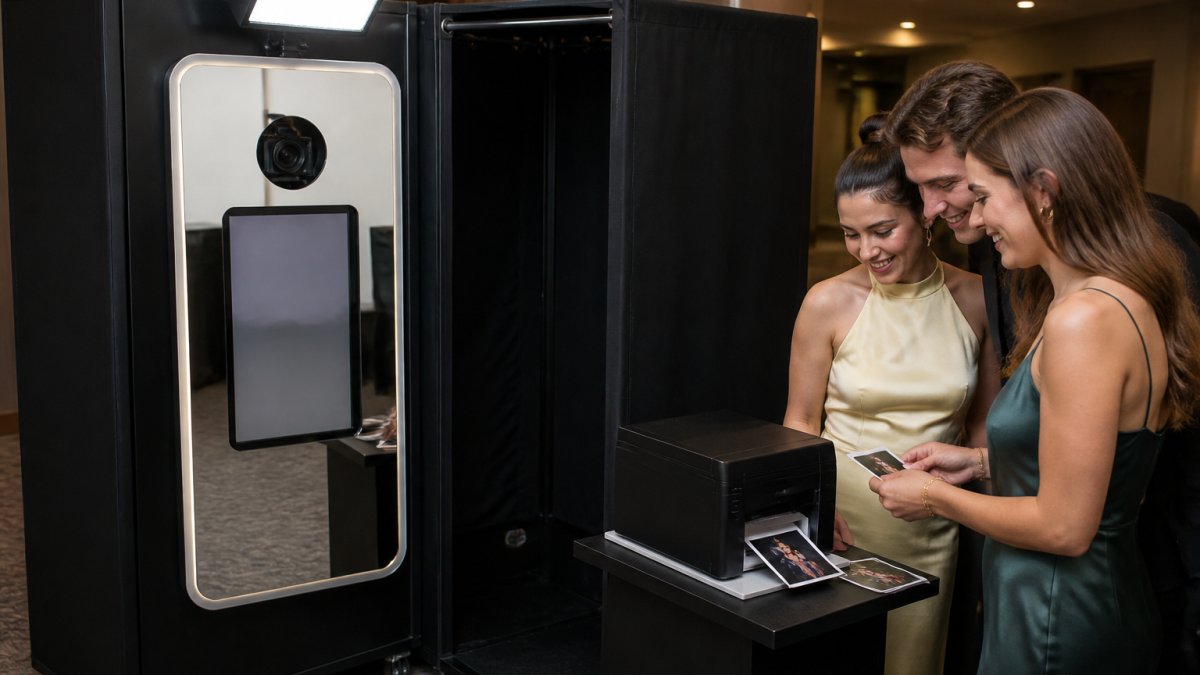
Camera, Lighting & Printer Setup
The camera is the foundation. Professional polaroid photo booths typically use Canon DSLR or mirrorless cameras mounted on a stable bracket inside the booth.
Lighting determines print quality more than any other factor.
The printer is where instant film technology meets final output.
Reliability is non-negotiable. A printer jam during a busy event costs you revenue and damages your reputation.
Touchscreen Interface & Hardware
The touchscreen interface is the guest's first interaction with your booth.
The underlying hardware, typically a compact NUC PC with 8GB RAM and 500GB SSD, must be reliable and fast.
A back-door sharing station (available on models like the Mirror Social Booth with Back Door Sharing Station - V3) adds significant value.

Starting a Photo Booth Business Startup: What You Need to Know
Launching a polaroid photo booth business requires more than equipment.
Mirror Social Booth with Back Door Sharing Station - V3 →
Business structure and licensing. Register your business as a sole trader, partnership, or company depending on your scale and risk tolerance.
CRM and booking systems. Managing client inquiries, contracts, and event schedules manually doesn't scale. Aussie Photo Booth Supplies offers specialised CRM setup and training services designed specifically for photo booth operators, helping you simplify operations and avoid the chaos of spreadsheets and scattered emails.
Pricing strategy. Research your local market.
Marketing and lead generation. Build relationships with wedding planners, corporate event coordinators, and venue managers.
Operational readiness. Before taking your first paid booking, test every component multiple times.
DIY Photo Booth Props & Backdrop Design
Props and backdrops transform a generic photo booth into a branded, memorable experience. They are also relatively inexpensive to create or source, making them ideal for operators looking to differentiate without major capital investment. This section goes beyond inspiration and covers the practical build, the print-to-social bridge most guides skip, and the waste problem props create.
Backdrop design that actually photographs well
A well-designed backdrop sets the mood and frames the photo. For weddings, elegant backdrops featuring florals, fabric drapes, or custom monograms work well.
DIY backdrops can be constructed from PVC pipe frames ($50 to $150) and fabric or vinyl backdrop material ($100 to $300). Professional-grade backdrops from event suppliers cost $300 to $800 but offer superior durability and visual impact.
Custom photo booth cutouts and props
Oversized cardboard or foam cutouts, speech bubbles, props like oversized glasses or signs, character silhouettes, add visual interest and encourage guest interaction.
For operators running multiple events, build a modular prop library rather than buying per-event. A core set of neutral props (frames, hats, signs) works across weddings and corporate bookings, while themed add-ons (tropical, festive, retro) can be swapped in.
Lighting props and accents
String lights, neon signs, or LED panels positioned around the booth frame add ambience and photograph well. These are not essential but significantly enhance the visual appeal and create Instagram-worthy backdrops that guests want to share.
Bridging prints and digital sharing
This is the gap most prop and backdrop guides miss. Guests want the physical print, but they also want to post it.
A back-door sharing station solves this.
If you are building DIY, you can approximate this with a tablet mounted beside the printer running a simple upload or QR-code sharing app.
Reducing prop and backdrop waste
Props and backdrops are the most disposable part of a booth setup. A few habits extend their life and reduce waste:
- Choose fabric backdrops over printed vinyl where possible; fabric can be washed and reused, vinyl often cannot.
- Store props in labelled, dust-proof containers so they survive multiple events instead of being replaced each season.
- Repair foam and cardboard cutouts with tape or a fresh coat of paint rather than discarding them after one event.
Photo Booth Hire Options & When to Rent
Understanding when to hire rather than purchase clarifies your business model.
When to hire. If you're a venue manager running 5 to 10 events per year, hiring eliminates capital investment and maintenance responsibility.
When to purchase. If you're launching a dedicated photo booth rental business, purchasing is essential.
Hybrid approach. Some operators purchase one booth for regular bookings and hire additional booths for peak season (wedding season, December parties).
Reliability & Troubleshooting for Instant Film Booths
Printer jams and media issues. The most common problem is paper jams or film cartridge misfeeds.
Lighting inconsistencies. LED lights can fail or dim unexpectedly.
Software crashes. Booth software occasionally crashes, particularly if the system is running older hardware or incompatible software versions.
Camera focus and exposure issues. Autofocus can hunt (fail to lock focus) in low-light conditions.
Building a successful polaroid photo booth business starts with understanding your equipment, your market, and your operational capacity. Our Mirror Social Booth with Back Door Sharing Station - V3 and Urban Retro Booth models are purpose-built for Australian operators, assembled locally to Australian electrical standards, and backed by CRM setup and training support designed to simplify your business operations and help you scale confidently.

Frequently Asked Questions
How do you set up a DIY Polaroid photo booth?
Start with a freestanding kiosk or enclosed booth structure, mount a supported camera (typically Canon) on a tripod, install studio LED lighting for even exposure, and connect a thermal or dye sublimation printer. Add a touchscreen interface to control shots and frame designs. Ensure the booth has proper power supply, a travel case for portability, and test shutter speed and aperture settings before your first event. Professional setups include a back door for guest access and branded frame options.
Is it cheaper to hire a photo booth or buy one outright?
Hiring typically costs per event, while purchasing ranges from $2,495 for refurbished entry-level models to $6,995 for new professional booths assembled to Australian standards. If you operate 20+ events annually, purchase can break even within 1-2 years. For occasional use (5-10 events yearly), hiring is more cost-effective. Buying also requires maintenance, consumables (instant film cartridges, media kits at $265+), and storage space. Consider rental if you're testing the market before committing to a photo booth business startup.
What equipment do I need for a professional-grade Polaroid photo booth?
You'll need a photo booth box with mirror face or open frame, a supported camera kit, NUC PC with 8GB RAM and 500GB SSD, studio-quality LED lighting, a touchscreen interface, an instant printer (Sinfonia CS2 or HiTi series), and consumables like media kits and film cartridges. A travel case ensures portability between events. Professional setups include a back door sharing station for guest access and custom photo frame props. High-quality prints depend on reliable dye sublimation technology and proper exposure compensation settings.
Are instant photo booths better than digital photo booths?
Instant film booths create physical prints guests take home immediately, enhancing event engagement and providing memorable keepsakes. Digital booths offer higher volume output and easy sharing but lack the tangible element. Instant booths can be a good fit for weddings, corporate events, and activations where party favours matter. Digital options suit events needing rapid processing. Many operators combine both: instant prints at the booth plus digital integration for social media sharing and event ROI tracking. The choice depends on your event type and audience expectations.
How reliable are instant film photo booths during back-to-back events?
Professional instant photo booths built to Australian electrical standards and compliance offer reliability when properly maintained. Common issues include printer jams and touchscreen glitches, both preventable through regular cleaning, firmware updates, and keeping spare media kits on hand. Dye sublimation printers like the Sinfonia CS2 offer consistent output across multiple sessions. Stock adequate film cartridges (at least 2-3 boxes) and test your camera shutter speed and aperture settings before each event. Refurbished models may have shorter warranties.